Skip Navigation

The Lead - More Momentum?

12.11.2025

The Lead - More Momentum?

Tags: Equity, Economic Updates

Low Quality (B or Worse) Leads High Quality (B+ or Better) in 2025

(12.2024 − 10.2025)

Throughout this year we have touched on the many unique aspects of 2025, including how certain characteristics may have impacted equity market returns and could have caused certain styles to perform. As we enter the month of December, we thought it would be helpful to take stock in what we believe has worked thus far in 2025 for market participants. Arguably, what we see as the most unique aspect of this year is how we seem to be in the midst of the biggest run for momentum stocks in the past seventy years. Momentum investing is when investors buy securities that are already rising─stocks that are “up” keep going “up.” The combination of retail investors with trend-following strategies have possibly helped fuel this trend, especially since April of this year. The chart to the right depicts the relative performance of momentum stocks recently and places the relative performance in historical context.

Within momentum stocks this year, what has been working? As seen in the chart above, it has been lower quality stocks based on S&P quality rating methodology. The chart groups overall quality in the yellow bars, but as can be seen, year-to-date within the low-quality cohort, it has been the lowest quality stocks that seem to have performed the best. Moreover, the difference has been striking, with the lowest quality stocks outperforming the next category by over 10%, and overall low-quality outperforming by over 8% through October.
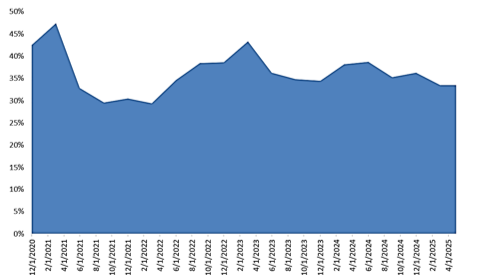
 

Large Cap Stocks Trailing 12-Month Relative Returns to Top Quintile of 9-Month Price Momentum
S&P 500® Performance by Next 12-Month P/E Ratio

(12.31.2024 − 11.30.2025)

Moreover, stocks with the highest valuations in the market also appear to have been the best performers. In the chart on this page we show how the most expensive stocks on an earnings basis (Quintile 1 stocks) have been the best performers with the least expensive stocks lagging year-to-date. We believe the bull case, or optimism for a continuation of this trend is that the possibility of additional Federal Reserve rate cuts this month and next year may help propel overall earnings growth to double digit levels in 2026.

Given the dynamics in 2025, we have been finding value in companies with high returns on equity, stable earnings growth, and low debt levels. In our opinion, the environment in 2025 has seemed to provide unique investment opportunities in companies that possess these traits.

As always thank you for your interest and trust managing your investments.


Disclosures

Past performance is not indicative of future results. Any type of investing involves risk and there are no guarantees that these methods will be successful. Economic charts are provided for illustrative purposes only. The information provided herein is subject to market conditions and is therefore expected to fluctuate.

The opinions contained in this presentation reflect those of Sterling Capital Management LLC (SCM), are for general information only, and are educational in nature. The opinions expressed are as of the date of publication and are subject to change without notice. These opinions are not meant to be predictions and do not constitute an offer of individual or personalized investment advice. They are not intended as an offer or solicitation with respect to the purchase or sale of any security. This information and these opinions are subject to change without notice. All opinions and information herein have been obtained or derived from sources believed to be reliable. SCM does not assume liability for any loss which may result from the reliance by any person upon such information or opinions.

Investment advisory services are available through SCM (CRD# 135405), an investment adviser registered with the U.S. Securities & Exchange Commission (SEC) and an indirect, wholly-owned subsidiary of Guardian Capital Group Limited. SEC registration does not imply a certain level of skill or training, nor an endorsement by the SEC. SCM manages customized investment portfolios, provides asset allocation analysis, and offers other investment-related services to affluent individuals and businesses.

Sterling Capital does not provide tax or legal advice. You should consult with your individual tax or legal professional before taking any action that may have tax or legal implications.

The securities described are neither a recommendation nor a solicitation. Security information is being obtained from resources the firm believes to be accurate, but no warrant is made as to the accuracy or completeness of the information.

The volatility of an index varies greatly. All indices are unmanaged and investments cannot be made directly in an index.

The S&P 500® Index is a readily available, carefully constructed, market-value-weighted benchmark of common stock performance. Currently, the S&P 500 Composite includes 500 of the largest stocks (in terms of stock market value) in the United States and covers approximately 80% of available market capitalization

Technical Terms: Quintile 1 stocks refers to a group of stocks that fall into the lowest 20% of a specific metric being measured (e.g., performance, quality, or value) within a defined universe of stocks. The price-to-earnings (P/E) ratio compares a company's share price with its earnings per share (EPS). Analysts and investors use this to determine the relative value of a company's shares in side-by-side comparisons. Return on equity (ROE) is a measure of a company's financial performance. It is calculated by dividing net income by shareholders' equity. (Technical definitions are sourced from Corporate Finance Institute and Investopedia.)

The Chartered Financial Analyst® (CFA) charter is a graduate-level investment credential awarded by CFA Institute — the largest global association of investment professionals. To earn the CFA charter, candidates must: 1) pass three sequential, six-hour examinations; 2) have at least four years of qualified professional investment experience; 3) join CFA Institute as members; and 4) commit to abide by, and annually reaffirm, their adherence to the CFA Institute Code of Ethics and Standards of Professional Conduct.

Since we began publishing The Lead in 2015, our primary purpose has been to communicate our investment philosophy and process as an investment advisor in the context of changing markets. In creating portfolios that differ from our benchmarks by focusing on characteristics that have a long term history of attractive relative returns according to Ned Davis Research, the portfolios are different from the benchmarks and as a result there can be periods where results differ including below benchmark performance. Since strategies are oriented toward the long term characteristics, if those characteristics are out of favor over a period of time, the given strategy’s performance could be challenged in terms of relative performance. While Sterling believes active professional investment management that employs a consistent process with a long term orientation and aligned with client interests offers benefits, management fees to support the active approach can be higher than certain alternatives. When hiring an investment manager we believe it is important to monitor the investment risks taken including sector concentrations, portfolio turnover, and the impacts of dividend policy changes.

About the Author


Photo of Charles Wittmann

Charles Wittmann, CFA®

Co-Portfolio Manager

Charles Wittmann, CFA®, Executive Director, joined SCM in 2014 and has investment experience since 1995. Chip is Co-Portfolio Manager of the Equity Income strategy. Prior to joining SCM, he worked for Thompson Siegel & Walmsley as a portfolio manager and (generalist) analyst. Prior to TS&W, he was a founding portfolio manager and analyst with Shockoe Capital, an equity long/short hedge fund. Chip received his B.A. in Economics from Davidson College and his M.B.A. from Duke University's Fuqua School of Business. He holds the Chartered Financial Analyst® designation and served as President of CFA Society Virginia from 2012-2013.

Related Insights


12.09.2025
Gregory Zage, CFA®, Justin Nicholson

The Sterling Capital VAULT: Passive Investing is NOT Static Investing

11.11.2025 • Charles Wittmann, CFA®

The Lead - The Flat Pause

Scroll Up