Deep Value vs. S&P 500 Total Returns
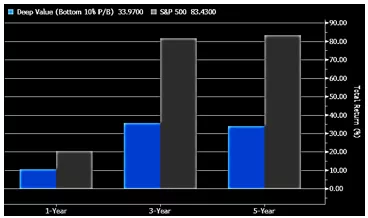
Over the past few years, we have discussed how periods of market weakness can, in certain circumstances, create investment opportunities. This month we have actively debated a recommendation where the primary thesis point was that it was “cheap.”
Are we value investors? Yes, but value is but one of our four investment pillars. Our investment philosophy comprises not only value, but considerations such as the competitive advantage a company should have to maintain and grow their return on capital. Also, does the company have excessive debt adding to the risk of the position, and is there a clear path to future growth, or does outlook seem mainly based on the possibility that results will return to historical norms?
What’s the point for clients? Stocks that are cheap on valuation may be risk masquerading as a cheapness signal. In this scenario, there seem to be three main problems.
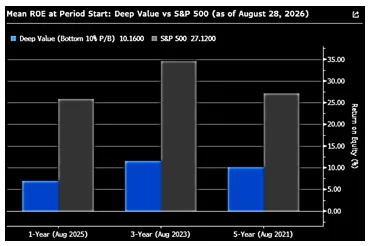
First, if returns on capital for cheap stocks tend to be just above their cost of capital, as seen in the second chart, there appears to be little room for error, hence risk as any growth could destroy value if returns on capital are below their cost.
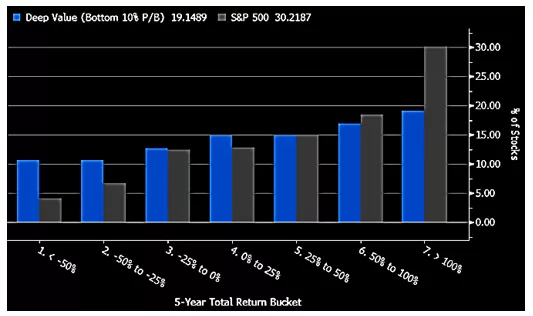
Second, as seen in this chart, this group of stocks over the past five years has had a negative skew in terms of their risk profile. In other words, the cheapest stocks also appeared to generate weaker returns than the market over this period. We believe this may have contributed to their overall pattern of underperformance as seen below.
Finally, how long is an investor willing to wait for the potential classic revision to the mean to occur?
By focusing on our four pillars, rather than just one, we aim to minimize these concerns in our investment decisions. By focusing on companies with higher-than-average returns on capital, we seek to minimize the risk of not earning our cost of capital.
In terms of timing, while the value-only investor appears to wait for an event to close the gap between the share price and their view of intrinsic value, companies with high returns on capital may be better positioned to compound value year after year. Quality stocks are seldom cheap, and many times periods of unfavorable news may create opportunity. But in scrutinizing new investment opportunities, we believe that work needs to be done not just in valuation, but valuation combined with the quality of the business that can be owned over a long period of time.
As always thank you for your interest and trust managing your investments.
About the Author

Charles Wittmann, CFA®, Executive Director, joined SCM in 2014 and has investment experience since 1995. Chip is Co-Portfolio Manager of the Equity Income strategy. Prior to joining SCM, he worked for Thompson Siegel & Walmsley as a portfolio manager and (generalist) analyst. Prior to TS&W, he was a founding portfolio manager and analyst with Shockoe Capital, an equity long/short hedge fund. Chip received his B.A. in Economics from Davidson College and his M.B.A. from Duke University's Fuqua School of Business. He holds the Chartered Financial Analyst® designation and served as President of CFA Society Virginia from 2012-2013.
Related Insights
10.07.2026
Gregory Zage, CFA®, Dusten Pulido, CFA®
The Sterling Capital VAULT: Banking on NIM - Why Steeper Isn’t Always Better
08.31.2026
James Kerin, CFA®, Gregory Zage, CFA®
07.14.2026 • Charles Wittmann, CFA®
06.23.2026
Gregory Zage, CFA®, James Kerin, CFA®