At its October 2026 meeting, the Federal Open Market Committee (FOMC) left the federal funds rate target range unchanged following a 25 bps increase at the September meeting. The new, trimmer October FOMC statement highlighted economic growth expanding at a strong pace, strong productivity growth, robust capital investment, and a stable unemployment rate. Meanwhile, inflation remains elevated relative to the Committee’s 2% goal. The statement has eliminated any discussion of the outlook for economic conditions and monetary policy in keeping with Federal Reserve (Fed) Chair Kevin Warch’s reduced emphasis on forward guidance.
The most noteworthy result from the October 2026 meeting was two dissenting votes from Governor Lisa Cook and Cleveland District Bank President Beth Hammack who preferred to raise the federal funds target range by 25 bps. With one more meeting expected to be held in 2026, the FOMC has logged 12 dissenting votes, which is the most annual dissents since 1984 - the Volcker years of inflation fighting. In this edition of The Sterling Vault, we update our analysis of FOMC dissenting votes.
FOMC Voting Explained
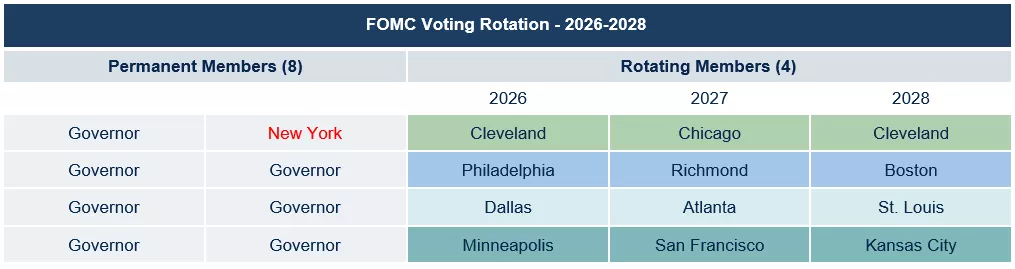
The FOMC is the main monetary policymaking body of the Federal Reserve (Fed). It includes both rotating and permanent voting seats for a total of 12. The eight permanent members are the seven Board governors and the president of the Federal Reserve Bank of New York. The remaining four FOMC votes rotate among the other 11 Fed bank presidents on an annual basis. These rotations are scheduled in advance, with districts taking turns in four groups that rotate in two-year or three-year cycles, shown below. While all 19 members of the committee are present at the FOMC meetings (7 governors and 12 bank presidents), only 12 votes are cast for policy decisions.
FOMC Dissents
Dissents, and in particular dissents at the same meeting in opposing directions, underscore the “art” of monetary policy as the economy reaches inflection points in terms of growth or inflation. Since the July 2025 FOMC meeting, there have been a total of 18 dissenting votes cast by a mix of Bank presidents (10 votes) and Board governors (8 votes). Governor Miran, during his short stay on the Fed Board, cast six consecutive dissenting votes in favor of additional or deeper interest rate cuts. Governor Waller cast the other vote by a Board member in favor of easing policy in January 2026, and now Governor Cook voted to tighten policy in October 2026. Meanwhile, five different Reserve Bank presidents have cast dissenting votes so far in 2026 in favor of tighter monetary policy.
Historically, dissents have served as a reminder of robust debate and diversity of viewpoints at the FOMC. Dissents normally reflect legitimate disagreements about the impact of policy and how to implement it, or about the current stance of policy compared to the FOMC objectives, and can potentially help market participants glean insight into the leanings of the Fed. In 2022, for example, former St. Louis Fed President James Bullard strongly argued for a more rapid pace of tightening due to his view that inflation was not transitory, a view that later proved accurate. This year, the District Bank presidents that dissented in July (Hammack, Kashkari, and Logan) had previously dissented in April in favor of a rate hike at Jerome Powell’s final meeting as Fed Chair. Following the October meeting, Fed Funds futures are pricing a more gradual tightening of monetary policy than it had been earlier this year.
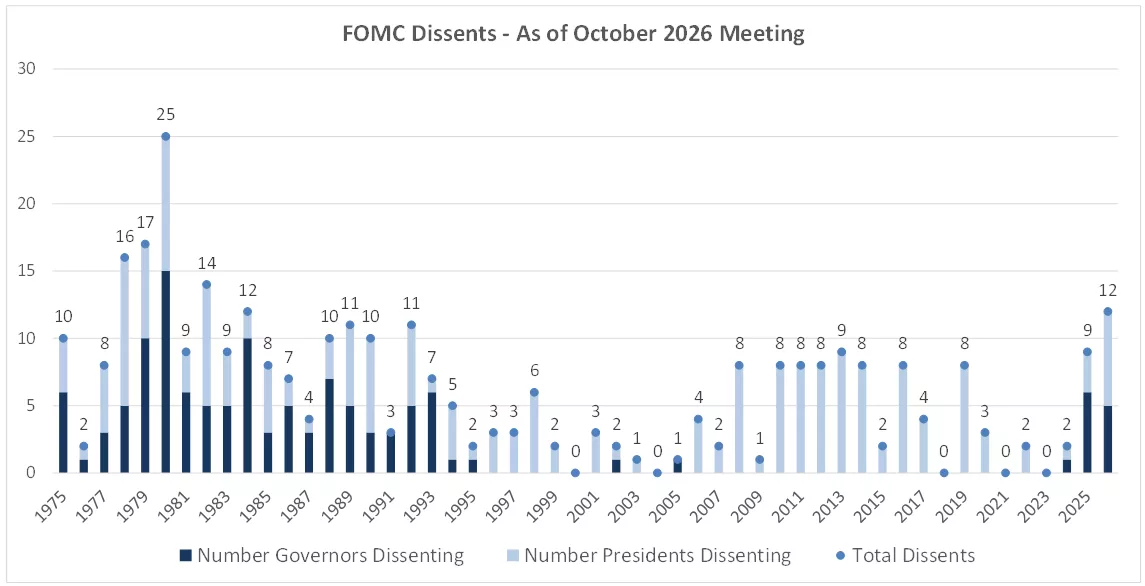
Since the early 1990s, dissenting votes have come primarily from District bank presidents, while governors have been viewed as more closely aligned with the Chair. Before Governors Waller and Bowman dissented in July 2025, two Fed Board governors had not dissented from an FOMC decision at the same meeting since 1993, according to data compiled by researchers at the Fed Bank of St. Louis. Bowman and Waller cited weakening labor fundamentals as the reason to ease policy rates.
Dissenting governors, and especially more than one at a time, can highlight the degree of difficulty in forming monetary policy in the current environment, and in our view may point to palace intrigue around the formation of the FOMC’s reaction function. There can be periods where the same person, or presidents of the same Reserve Bank, votes to dissent from an action taken by the Committee. For example, the Fed Reserve Bank of Kansas City or FRBKC (Hoenig and George) became known for dissenting in favor of tighter policy actions during the quantitative easing period following the Great Financial Crisis. This mantle has been taken up at times over the past year by current FRBKC President Schmid.
With changes in communication instituted under Chair Warsh regarding forward guidance, the meeting statement, and the press conference (assuming those continue in the future), public statements by Governors and Bank Presidents may be closely analyzed to help fill in the gaps. Policy consensus on the FOMC is the norm, which may make this period of dissenting views even more challenging for market participants positioning portfolios going forward.
About the Author

Gregory Zage, CFA®, Executive Director, joined SCM in 2007 and has investment experience since 2007. Gregory is a Senior Fixed Income Portfolio Manager and Head of Fixed Income Trading. He is currently responsible for all trading activity across SCM's fixed income desks. Previously at SCM, he was responsible for high-grade corporate credit trading and municipal credit trading. Gregory received his B.A. in Economics with a minor in Spanish from Davidson College. He holds the Chartered Financial Analyst® designation.
Related Insights
10.23.2026 • Peter Brown, CFA®
The Sterling Capital VAULT: The 2026 U.S. Midterm Elections & Fixed Income Market
10.13.2026 • Charles Wittmann, CFA®
10.07.2026
Gregory Zage, CFA®, Dusten Pulido, CFA®
The Sterling Capital VAULT: Banking on NIM - Why Steeper Isn’t Always Better
09.11.2026 • Charles Wittmann, CFA®