Executive Summary
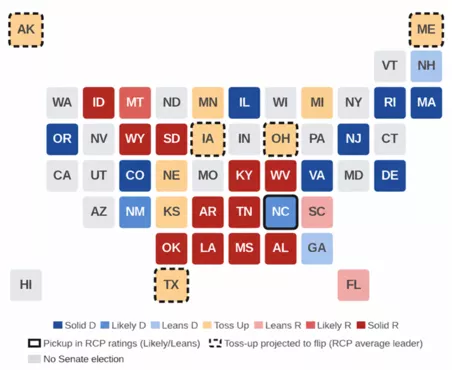
We expect the November 2026 midterm elections to have a limited direct impact on the U.S. bond market. Fixed income markets typically discount anticipated outcomes well in advance, and the largest election-driven moves, such as the 2016 U.S. presidential election and the Brexit referendum, have followed genuine surprises, in our view. Current polling points to Democratic gains, a consensus shared by most investors. In our opinion, the most meaningful impacts of the midterm elections may play out over a longer time horizon through fiscal policy and Treasury supply, a probable 2027 debt ceiling confrontation, and the composition of the Federal Reserve (Fed) Board, which hinges on control of the Senate.
Historical Precedent & Election Scenarios
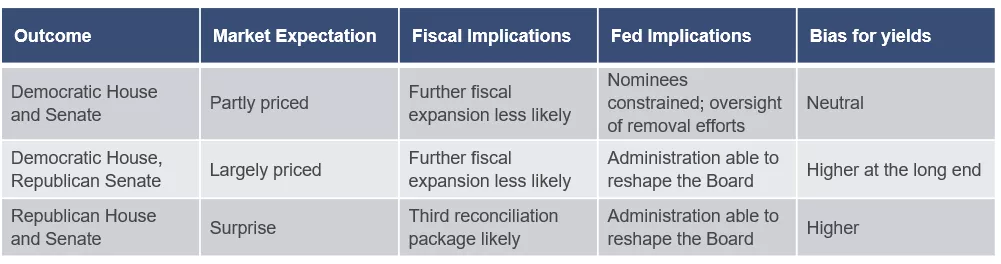
Recent midterms that shifted congressional control produced modest immediate reactions. The 2018 Democratic takeover of the House, midway through President Trump's first term, was widely anticipated and had little market impact, in our view. Sharp moves in interest rates over the following two months were the result of trade tensions with China and growth concerns amid Fed tightening, conditions not dissimilar to the current environment. In 2006, when Democrats won both chambers midway through the President Bush’s second term, yields declined in the run-up to the vote, eased modestly afterward, and ended the year broadly unchanged.
The consensus expectation is that Democrats regain the House and contest the Senate, given the President's negative net approval ratings. Any resulting majority is unlikely to be veto-proof, in our view, however, the legislative landscape may differ slightly from the past two years, in which the One Big Beautiful Bill Act was the primary piece of legislation. Divided government could lower the probability of further fiscal expansion and incremental Treasury issuance, although Democrats do not appear to be fiscal hawks, in our opinion.
Fiscal Risk: A Republican Surprise & the Debt Ceiling
In our opinion, a Republican sweep remains out of consensus but may potentially be the highest impact scenario. This may raise the likelihood of another reconciliation package, potentially including a larger increase in defense spending, effectively rule out tax increases, and extend the administration's expansionary fiscal stance. Given the market's perception of Republican governance as business-friendly, investors could potentially revise growth forecasts upward, which may place upward pressure on yields in the immediate aftermath.
Regardless of the outcome, government funding and the debt ceiling may require attention in 2027. Three shutdowns occurred during the first two years of this term despite unified Republican control. Shutdowns, however, have historically limited bond market impact, in our view.
The debt ceiling is more consequential, in our opinion. Brinkmanship has twice contributed directly to sovereign downgrades: S&P lowered the U.S. from AAA to AA+ in 2011 after the standoff that produced the Budget Control Act, with Fitch following in 2023 after a dispute between the Biden administration and a Republican House. The One Big Beautiful Bill Act raised the debt limit by $5T in 2025, which we expect to provide headroom only into 2027. Although Democratic Houses have historically been less obstructionist on the debt ceiling, the current political climate may suggest a renewed standoff could be a meaningful risk.
Federal Reserve Composition: The Most Significant Channel
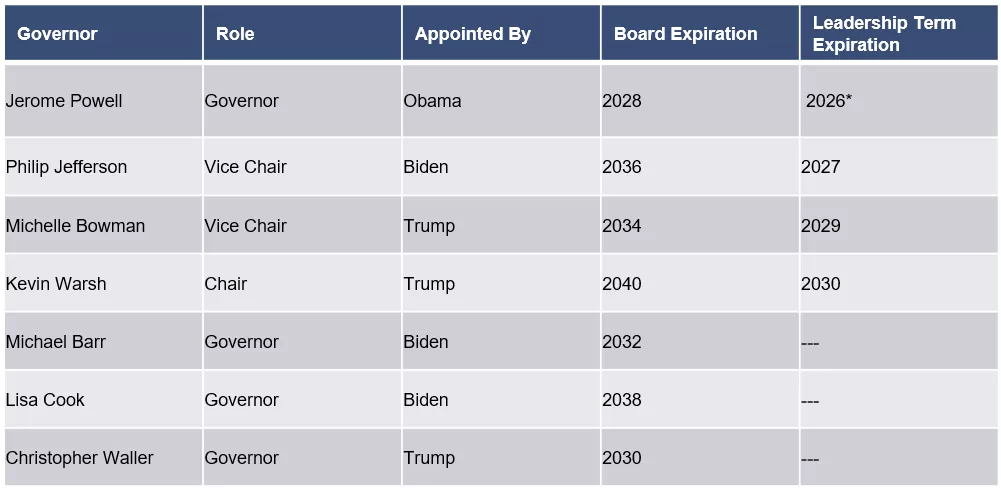
Senate control may matter most for fixed income investors, in our view, through the midterm election results’ impact on the Fed. While he may step down sooner, Jerome Powell's term as a governor expires in January 2028. A Republican Senate majority may make for an easier confirmation process to replace Powell with a successor of the President’s choosing, while potentially having a greater impact if the White House succeeds in removing Governor Lisa Cook, or others, from the Fed. In such a scenario, Trump appointees may constitute the majority of the Board, which may allow the Fed to pursue a more accommodative path, consistent with the President's stated preference for lower rates. In our opinion, this may potentially invite further questions about central bank independence. Both developments may potentially raise the term premium, inflation expectations, or both, and with them potential longer-term yields.
A Democratic Senate may compel the administration to nominate more independent-minded candidates or leave seats vacant. Democrats could also gain committee control, including subpoena power and the ability to hold oversight hearings on removal efforts. Legislation protecting Fed independence could advance, though may potentially face a presidential veto, in our view.
Sector Considerations
At the state level, Democratic gains may intensify political pressure to slow AI and data center development. Over several quarters, this could reduce capital expenditure funding needs for hyperscalers and frontier AI developers, which could moderate corporate bond issuance, including data center and semiconductor-related financings. Separately, a number of state ballot measures may affect specific segments of the U.S. municipal market.
Conclusion
We do not anticipate a material repricing in the immediate aftermath of the midterms, with the exception of an unexpected Republican sweep, which may carry potential upside risk to yields. For institutional investors, we believe the more durable implications lie in 2027 and beyond: a likely debt ceiling confrontation with attendant credit rating risk, and a Senate outcome that may shape the composition of the Fed and, by extension, the long end of the Treasury curve.
About the Author

Peter Brown, CFA®, Managing Director, joined SCM in 2004 and has investment experience since 2000. Pete is a Fixed Income Portfolio Manager and Head of SCM's Investment Grade Credit team. Prior to joining SCM, he held financial analyst positions at National Institutes of Health and First Union National Bank/First Union Securities. Pete received his B.S. in Statistics with minors in Business Management, Marketing and Communications from Cornell University and his M.B.A. from Wake Forest University. He holds the Chartered Financial Analyst® designation.
Related Insights
10.13.2026 • Charles Wittmann, CFA®
10.07.2026
Gregory Zage, CFA®, Dusten Pulido, CFA®
The Sterling Capital VAULT: Banking on NIM - Why Steeper Isn’t Always Better
09.11.2026 • Charles Wittmann, CFA®
08.31.2026
James Kerin, CFA®, Gregory Zage, CFA®